- Blog
- Travel Tips & Hacks
- Winter solo travel tips: how to plan, stay safe, and handle flight disruption alone
Winter solo travel tips: how to plan, stay safe, and handle flight disruption alone


Traveling alone in winter brings two extra worries: dark afternoons, and a bigger chance that snow or storms mess with your flight, with nobody beside you to help sort it out. The good news is that a few winter-specific solo travel tips, plus the right app on your phone, take care of most of it. Here’s what to do, what to skip, and exactly what to do if your flight goes wrong.
Solo winter travel at a glance
Do this | Not that |
|---|---|
Book a morning flight | Take the last departure of the day |
Leave hours between separate bookings | Book a tight self-transfer on two tickets |
Stay somewhere central and well reviewed | Save money on a room that’s a long walk from anywhere after dark |
Plan sightseeing around daylight | Assume it’s light until 6 p.m. |
Set up live flight alerts before you leave | Rely on the departures board |
Keep every receipt if your flight is disrupted | Throw away proof of what you spent |
Share your plans and a daily check-in time | Go off the radar |
How do you plan a solo trip in winter?
The best solo travel tips for winter come down to timing and buffers. Book morning flights, since early departures are less likely to be hit by knock-on delays that build up through the day. Avoid tight connections on separate tickets. Stay somewhere central and well reviewed so you’re not walking far after dark, and check sunset times before you plan your days. Finally, share your itinerary with someone at home and set up live flight alerts before you leave.
A few extra things make solo trip planning easier in winter:
Respect the buffer. If you book two flights on separate tickets and the first one is late, the second airline doesn’t have to help you. On one booking, the airline has to get you to your final destination.
Pick your base for the dark, not the daytime. A slightly pricier room near a main square or station often pays for itself in taxi fares and peace of mind.
Allow extra time at the border. If you’re not an EU citizen, Europe’s new Entry/Exit System now records your fingerprints and photo when you enter the Schengen area, so lines can be longer.
Know what winter does to flights. Snow, ice and de-icing all slow things down. It helps to understand how winter weather really affects your flight.
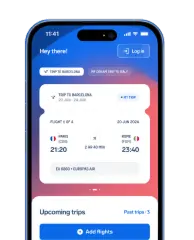
Then set up alerts. The free AirHelp app tracks your flight and pings you about delays, cancellations, and gate or terminal changes. You can add your flight by number, by scanning your boarding pass, or by letting the app pull it from your email. If you’re comparing options, here’s our roundup of the best flight tracker apps.
How do you stay safe traveling alone in winter?
Staying safe as a solo traveler in winter means planning around the dark. In much of northern Europe it can be dark by mid-afternoon in December, so do your exploring early and know how you’ll get back. Use licensed taxis or ride-hailing at night, wear shoes with grip, and keep a charged power bank, since cold drains phone batteries fast. Save 112, the free emergency number that works across the EU, and agree a daily check-in time with someone at home.
A few more solo travel safety tips that matter more in winter:
Download offline maps. Fumbling with your phone on a dark, icy street is exactly what you want to avoid.
Share your live location with one trusted person for the duration of the trip.
Watch your step, literally. Slips on ice are one of the most common winter travel injuries. Check that your travel insurance covers medical care abroad.
Trust your gut. If a street, bar or ride feels wrong, leave. You don’t owe anyone politeness at the expense of feeling safe.

What if your flight is delayed or canceled and you’re traveling alone?
This is the part most solo travelers dread, and with good reason. Winter storms can ground hundreds of flights at once: in January 2026, a single storm led to more than 1,200 cancellations at Amsterdam Schiphol. When it happens, everyone rushes the same desk. Here’s how to stay a step ahead.
Get the facts first. Check your flight alert and the airline app before you join the crowd. Knowing whether you’re delayed or canceled changes what you ask for.
Multitask. Join the desk line, and at the same time try to rebook on your phone. Whichever works first wins.
Ask for care. If you’re stuck for a long time, the airline should provide meals and drinks. If you’re delayed overnight, it should also provide a hotel and transport to it.
Keep every receipt. Food, taxis, a hotel you had to book yourself: you may be able to claim these costs back later.
Check compensation once you’re home. No need to argue at the airport. You can check later.
If your flight is delayed or canceled while you’re traveling alone, get the facts first, then multitask. Open your flight alerts and the airline app, and start rebooking on your phone while you queue at the desk. Keep every receipt. Bad weather usually counts as an extraordinary circumstance, so compensation may not apply, but the airline still has to look after you with meals and, if needed, a hotel. If the real cause was something else, you could be owed compensation.

Exceptions to know about
Weather usually rules out compensation, but not care. Under EC 261, the European air passenger rights law, severe weather is normally outside the airline’s control. Here’s what counts as extraordinary circumstances.
Not every winter delay is the weather’s fault. If the real cause is a technical fault or a staffing problem, you could be owed up to €600. Our guide to compensation for weather delays explains the difference.
Separate tickets aren’t protected. If a delay makes you miss a flight on a different booking, you’re usually on your own. Here’s what to do if you miss a connecting flight.
For the official rules, see your EU air passenger rights. The AirHelp app also checks your rights automatically when a delay hits, and you can check if your flight qualifies at any time.
Practical solo travel tips for short winter days
Do the big sights in daylight. Save museums, cafés and indoor markets for after dark.
Book a few evenings in advance. A concert, a food tour or a Christmas market walk means long winter nights don’t turn lonely.
Eat at the bar. It’s the easiest seat for a solo diner, and the best spot for a chat.
Pack layers in your carry-on. If your checked bag is delayed, you won’t be stuck shivering on day one.
Take your own photos. A small tripod or timer solves the “can you take one of me?” problem.
FAQ
Travel solo with confidence. Let the AirHelp app have your back
When you travel alone, there’s nobody watching the departures board for you. The free AirHelp app tracks your flights in real time, alerts you the moment something changes, and tells you if you could be owed up to €600. It’s no surprise that over a million travelers use the AirHelp app.