- Blog
- Flight Terminology & Logistics
- What's the tiny hole in the airplane window for?
What's the tiny hole in the airplane window for?

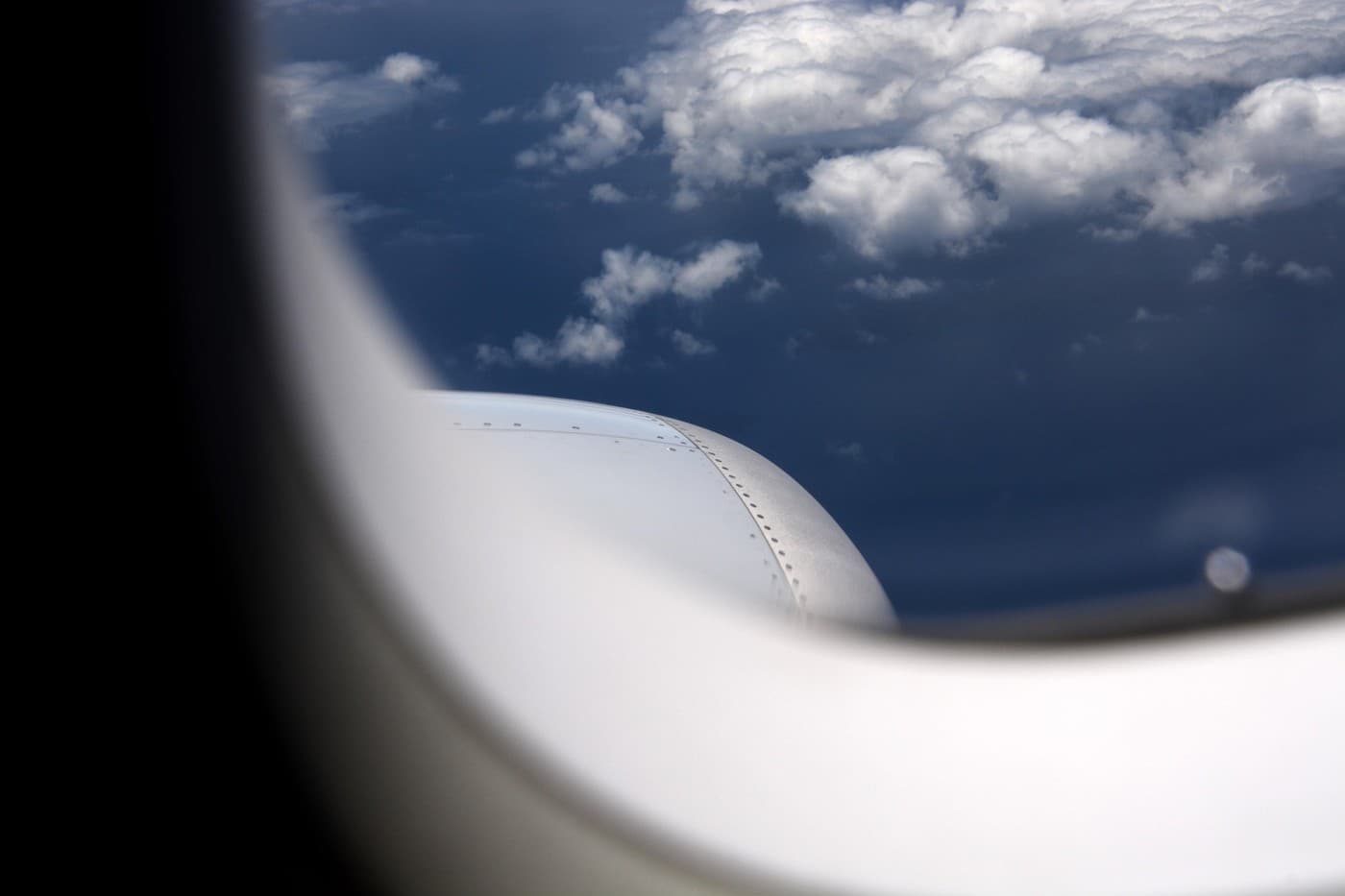
If you've ever snapped a photo from a window seat, you've probably spotted it: a tiny hole near the bottom of the pane. Don't worry, it's meant to be there.
That tiny airplane window hole is called a bleed hole, or breather hole. It's drilled into the middle of three acrylic panes. It lets air flow between the cabin and the small gap behind it, so the pressure stays balanced. That means the strong outer pane takes the strain of flying high, while the middle pane stays in reserve as a backup. The hole also lets moisture escape, which helps keep your view clear of fog and frost.
Why is there a hole in airplane windows?
It all comes down to pressure.
At cruising height, about 10,000 to 12,000 meters (33,000 to 40,000 feet) up, the air outside has roughly a quarter of the pressure you feel at sea level. Inside, the cabin is pressurized so you can breathe comfortably. That difference pushes hard on every window.
Curious about the other big numbers up there? Here's how fast planes fly at cruising altitude.
The bleed hole lets cabin air into the gap between the outer and middle panes. With the pressure matched on both sides of the middle pane, the full load lands on the outer pane. And that pane is built to carry it.
How do the three window panes work together?
Most passenger windows have three panes, and each one has its own job.
Pane | Where it is | What it does | Has the hole? |
|---|---|---|---|
Outer pane | Facing the sky | The main structural window. Holds back the pressure difference. | No |
Middle pane | In between | The backup. Strong enough to take over if the outer pane ever cracks. | Yes |
Inner pane | Next to you | The "scratch pane." Protects the other two from knocks and scratches. | No |
The hole has a second job, too. At cruising height, the air outside can be colder than −50°C, so the panes get very cold. Any moisture trapped in the gap could fog up the window or freeze. The bleed hole lets that moisture escape, so your view stays clear. On a long flight, you may even spot little frost crystals forming around it.

Why are airplane windows round, not square?
Here's the second surprisingly simple reason: sharp corners concentrate stress.
On every flight, the cabin is pressurized and then depressurized. That repeated flexing gathers at any corner in the metal around an opening.
In the 1950s, investigators traced fatal breakups of the de Havilland Comet, the world's first jet airliner, to metal fatigue around square-cornered openings in its body. Since then, airliners have used rounded windows, which spread the stress evenly along their curves.
So the shape of your window and the hole in it are part of the same idea. Both are there to manage pressure safely.
What does the airplane window hole mean for you?
Mostly, it means you can relax and enjoy the view. A few things to know from your window seat:
It's normal. You'll find the hole on almost every passenger window of a commercial jet.
It's easy to keep out of photos. Hold your phone close to the window and angle it slightly away from the hole.
It's a great icebreaker. Next time your seatmate peers at the window, you can tell them what the little hole is for and become the trivia master of your row.
Frost is fine. Ice crystals near the hole are just frozen moisture, and they fade as you descend.
Windows play a part in cabin safety in other ways, too. Here's why window shades have to be up for takeoff and landing.
Frequently asked questions
Is the hole in an airplane window dangerous?
No. It's a deliberate safety feature. The hole only goes through the middle pane, so the outer pane still seals the window completely. It keeps the backup pane free of strain, so it's ready if it's ever needed.
What are airplane windows made of?
Passenger windows are made of stretched acrylic, a tough, lightweight plastic. It's not glass. Acrylic resists cracking and weighs less than glass, which matters on a plane with dozens of windows.
Can an airplane window break?
It's very rare. Each window has two structural panes, and either one can hold the cabin pressure on its own. If the outer pane cracks, the middle pane takes over. Pilots will usually descend to a lower altitude as a precaution.
Why don't airplane windows line up with the seats?
The aircraft maker decides where the windows go. But each airline chooses its own seat layout and legroom. Add more rows or space them out, and the seats drift out of step with the windows. That's why some window seats get a great view and others mostly get wall.
Can you open an airplane window?
No. Passenger windows are sealed into the plane and can't be opened, because the cabin is pressurized in flight.