- Blog
- News & Updates
- Summer 2026 flight disruptions: are you owed compensation?
Summer 2026 flight disruptions: are you owed compensation?

.jpg&w=1920&q=75)
If your flight was delayed or canceled this summer, there's a good chance you're owed compensation for it — up to €600 per person, depending on how long you were delayed and how far you were flying.
You wouldn't be alone. Between June and August 2026, around 91.6 million passengers across Europe faced a delay or a cancellation — roughly 1 in every 4 people who flew. In the US, it was closer to 1 in 3. So if your summer trip didn't go quite to plan, you were in very good company.
Here's how the summer played out across Europe and the US, where things went smoothest (and where they didn't), and what to do if you think you're one of the millions who's owed compensation.
So how much could that actually be worth?
Under EU and UK rules, compensation depends on how far you were flying and how long the delay was — not on what you paid for your ticket. Short flights (under 1,500 km) can qualify for €250, medium-length flights (1,500 to 3,500 km) for €400, and longer flights for up to €600. AirHelp checks the details for you and handles the whole claim on your behalf — from filing the paperwork to following up with the airline.

Which countries had the toughest summer for flight disruptions?
If you flew to or from Greece this summer, you probably felt it: 41.2% of passengers there — around 6.6 million people — dealt with a delay or cancellation. Albania (33.5%) and Montenegro (32.5%) had a similarly rough few months, followed by Italy (32.3%) and Switzerland (31.5%).
Where did travelers have the easiest time?
Not every destination had it so bad. Lithuania had the smoothest summer in Europe, with just 14% of passengers affected — around 158,700 people. Norway (14.5%, 1.16 million passengers) and Moldova (14.9%, 168,800 passengers) followed close behind. If you flew through any of these this summer, you were more likely to land on time than not.
What about flights that got canceled outright?
Cancellations sting more than delays, since there's often no "eventually" — your original flight just isn't happening. North Macedonia saw the highest cancellation rate in Europe, at 3.5% (around 30,000 passengers), followed by Italy (3.3%, 1.3 million passengers) and Moldova (3.3%, 37,300 passengers). Romania (3.2%) and Bosnia and Herzegovina (2.8%) rounded out the top five. Across Europe, more than 5.5 million passengers had a flight canceled within 30 days of departure this summer.
How did the US compare?
If you thought disruptions were mainly a European problem, the US tells a different story. Its overall disruption rate was 29.3%, slightly higher than Europe's 27.5% — and up from 28.4% the summer before.
It showed at the airport level too. Dallas Fort Worth had the toughest summer of any major US hub, with 36.6% of passengers hit by a delay or cancellation — on par with some of Europe's worst-performing countries. Nashville (35.4%), Reagan National (34.9%), and Chicago O'Hare (34.3%) weren't far behind. Minneapolis−St Paul (23.2%) and Salt Lake City (22.2%) were the calmest of the major hubs.
Where did disruptions hit travelers' wallets hardest?
Looking just at passengers who faced a serious disruption — a delay of two hours or more, or a cancellation — the US saw the biggest overall impact of any market, affecting over 16.3 million passengers at an estimated cost of more than $9.4 billion. Europe followed closely, with 10.6 million passengers affected and around €5.4 billion in cost. Among individual European markets, Italy topped the list at roughly €1.2 billion, ahead of Spain, the UK, France, and Brazil.
Am I owed compensation for my delayed or canceled flight?
If your flight departed from Europe, or landed in Europe with a European airline, you could be entitled to €600 if it was delayed by three hours or more, or canceled with less than 14 days' notice — as long as the disruption wasn't caused by extraordinary circumstances outside the airline's control. Based on this summer's data, over 3.7 million passengers in Europe alone had a valid claim between June and August.
How can the AirHelp app help before, during, and after a disruption?
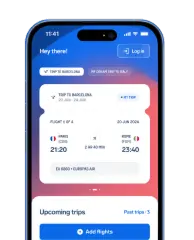
Compensation is great once a disruption's already happened — but the earlier you know something's changed, the more time you have to actually do something about it. That's where the AirHelp app comes in, at every stage of your trip:
Before you fly: real-time tracking flags delays before they show up on the departure board, so you're not the last to know.
During your trip: gate changes, delay updates, and baggage information land straight on your phone, so you're never stuck guessing.
After you land: if your flight qualifies, the app tells you automatically — no digging through fine print, no guesswork on whether you're owed anything.
With disruption rates this high on both sides of the Atlantic, that kind of head start is worth having in your pocket.


.png)