- Blog
- Compensation & Passenger Rights
- What are your rights for self connecting flights?
What are your rights for self connecting flights?

Short answer: if you booked your flights on separate tickets and a delay makes you miss the next one, you’re usually not protected — no free rebooking, no compensation. You’re only covered when both flights share a single booking reference.
Self-connecting flights can save you a small fortune. But that bargain comes with a catch most travelers never spot until they’re sprinting through a terminal watching their second flight push back without them. Here’s exactly where you stand, why the rules work the way they do, and the simple moves that turn a risky self-transfer into a smart one.
What is a self-connecting flight?
A self-connecting flight — also called a self-transfer or non-protected transfer — is when you piece together your own journey from two or more separate bookings, instead of buying one ticket for the whole trip. Maybe you pair a low-cost carrier’s first leg with a different airline’s second leg because it’s cheaper, or because no single airline flies your exact route.
Everything hinges on one thing: how many bookings you’re holding. On a single through-ticket, the airline chose the connection, so it’s on the hook for getting you to your final destination. On separate tickets, each flight is its own contract — and no airline ever agreed to connect them.
Through-ticket (one booking) | Self-transfer (separate tickets) | |
|---|---|---|
Who’s responsible for the connection? | The airline | You |
Free rebooking if you miss it? | Yes, if the airline caused the delay | No — you rebook and pay again |
Compensation possible? | Up to €600 under EC 261 if 3+ hrs late | No, for the missed self-connection |
Bags checked through? | Usually yes | No — collect and re-check |
Are self-connecting flights protected?
Here’s the test that decides everything: do your flights share one booking reference? If yes, you’re on a single contract. Miss your connection because the first leg ran late through the airline’s fault, and the airline must rebook you for free — and if you reach your final destination 3 or more hours late, you could be owed up to €600 under EC 261. You can dig into the details in our guide to what to do when you’ve missed your flight.
If your flights carry two separate booking references, though, the airlines treat them as unrelated trips. Miss the second one because the first was delayed, and in most cases you’re on your own — you buy a new ticket, and there’s no compensation for the leg you missed. Your wider rights across Europe are summarized neatly on the EU’s Your Europe air passenger rights page.
Who’s liable when you miss a self-transfer?
On a self-transfer, liability sits with you — that’s the trade-off for the lower fare. The first airline did its job by getting you to the connecting airport (even if late); it never promised to deliver you to the second flight. The second airline sees only a passenger who didn’t show. Neither owes you a rebooking.
That said, you’re never completely without options. If the delay on your first leg was the airline’s fault and that flight on its own qualifies under EC 261, you may still have a claim for that delay — separate from the connection you missed. And if you miss a connection on a single booking, it’s treated just like any other delay; there’s more in our guide to flight delay compensation.
Does the 2026 EU 261 reform change this?
It’s the question of the year, so let’s be straight about it. In June 2026, EU lawmakers reached a provisional deal to update EC 261. The headlines kept the 3-hour delay threshold and the familiar €250 to €600 compensation bands, with the practical changes landing around late 2027.
But here’s the part that matters for self-connectors: the reform doesn’t touch the single-booking rule. Separate tickets stay unprotected. So the smartest protection in 2026 is still the oldest one — one booking reference, or cover that fills the gap. You can follow the detail of what is changing in our guide to the 2026 EC 261 reform.
A simpler way to cover the gap: AirHelp+
Here’s the thing about self-transfers: you can do everything right — book smart, leave a buffer, plan for the bags — and a single delayed first leg can still leave you stranded with no airline on the hook. That’s exactly the gap AirHelp+ is built to close. Instead of hoping the dominoes stay standing, you travel with a safety net that pays out fast when they don’t.
For self-connectors, two member benefits do the heavy lifting. Missed connection insurance pays a fixed €200 within days if a delay on a covered booking makes you miss your connection and arrive late — money in your account while you sort out the next flight, no fault to prove and no airline to chase.
Flight disruption insurance adds a further €100 if your flight is delayed 3+ hours, canceled at the last minute, or diverted. And if disruption strikes on a single-booking leg that qualifies under EC 261, AirHelp’s experts will claim your airline compensation of up to €600 too — with no service fee taken.
There’s comfort built in for the waiting, as well: members get access to 1,300+ airport lounges worldwide when a flight is delayed an hour or more, so a long layover becomes a quiet seat and a coffee rather than a crowded gate. For anyone who flies self-transfer routes more than once or twice a year, it’s the difference between dreading the tight connection and shrugging it off. You can see how the protection works in the AirHelp app.

How to protect yourself on self-connecting flights.
AirHelp+ is the real solution, but if you’re willing to take the risk… here are 3 ways you can fly self-transfer with confidence:
Book on one ticket where you can. A single booking reference is the simplest protection going — the airline owns the connection, not you.
Leave a generous layover. Forget the minimum connection time. Give yourself hours, not minutes, especially if you’re re-checking bags or changing terminals.
Plan for the bag shuffle. On separate tickets you usually collect your luggage and check in again, which quietly eats into your layover — build that time in.
And if the worst happens at the airport, don’t freeze: head straight to the transfer or service desk, ask to be rebooked on the next flight to your destination, and keep every receipt in case you can recover costs later.
Frequently asked questions
Are self-connecting flights protected?
Not usually. You’re only protected when both flights are on one booking reference. With separate tickets, the airlines treat each leg as its own trip, so there’s no free rebooking or compensation if you miss the connection.
Who is responsible if I miss a self-transfer?
You are, in most cases. The exception is when both flights are on one booking and the first airline caused a delay of 3 hours or more to your final arrival — then the airline is responsible and may owe compensation.
Can I claim compensation for a missed self-connection?
Only if your flights were on a single booking covered by EC 261 and you arrived 3+ hours late through the airline’s fault. For separate tickets there’s no compensation for the missed leg — though you may still claim for the original delay if it qualifies on its own.
How do I protect myself on a self-connecting flight?
Simple answer: become an AirHelp+ member and relax when you fly. With missed connection insurance, flight disruption insurance, luggage insurance, lounge access, and much more, a flight problem will never be the stressful experience it once was.
Alternatively, book on one ticket if you can, leave a generous layover, and factor in re-checking bags Together these turn a risky self-transfer into a more manageable one.
Worried about a tight self-connection?
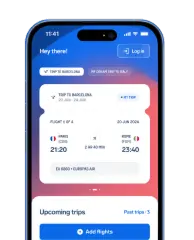
If you’re building your own connection, a little protection goes a long way. The AirHelp app tracks your flights in real time and flags the moment you’re owed up to €600 on an eligible booking — and it’s where you can add cover for the gaps a self-transfer leaves wide open. Worried about a tight self-connection? Check your protection in the AirHelp app.



.jpg%3Ftr%3Df-auto&w=3840&q=75)