- Blog
- Compensation & Passenger Rights
- EC 261 reform: 5 new protections for passengers with disabilities and reduced mobility
EC 261 reform: 5 new protections for passengers with disabilities and reduced mobility

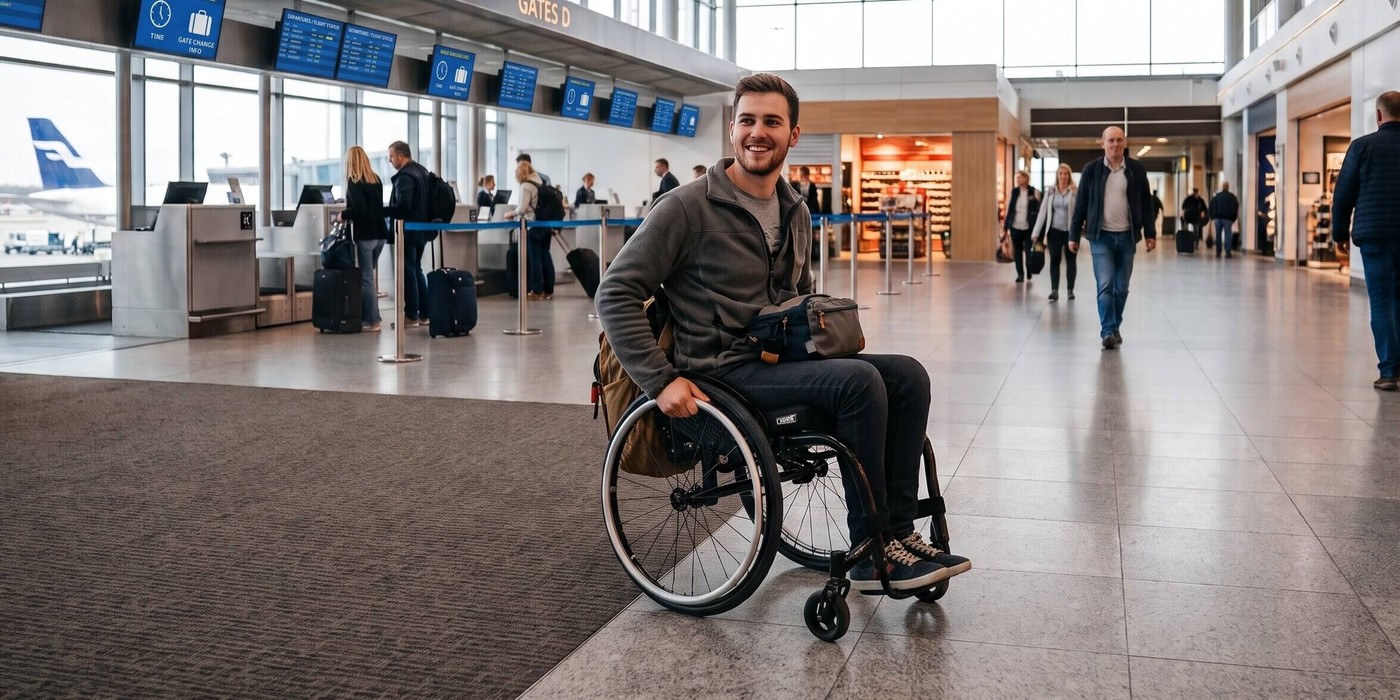
July is Disability Awareness Month, and this year there's genuinely good news to mark it with: the reform of EC 261. The EU has just voted to revise Europe's air passenger rights law and include real new protections for passengers with disabilities and reduced mobility (often shortened to PRM).
Here's what's changing, in plain English.
A quick note before we dive in: this reform was officially accepted by the EU Parliament on 7th July 2026. It is expected to take effect in the second half of 2027. Until then, these are the current rights of air passengers with disabilities.
5 new protections on the way
1. No extra connections without your consent
If your flight is disrupted and you need rerouting, airlines currently can end up placing PRM passengers on itineraries with more connections than their original trip — often through airports where no assistance has been arranged. Under the reform, that can no longer happen without your explicit agreement.
In practice: imagine that you’re a wheelchair user flying directly from Lisbon to London and get rerouted after a cancellation onto a two-leg trip via Madrid — an airport where no special assistance was booked and where a tight connection makes wheelchair transfer risky. Today, that can happen without asking. Under the reform, the airline would need the passenger's agreement first.
2. Assistance follows you to the rerouted flight
If you'd already arranged assistance for your original journey, airlines will be required to make sure equivalent assistance is available on your new, rerouted flight too — so you won't have to start the request process over again just because your flight changed.
In practice: a passenger who pre-booked meet-and-assist at both ends of their original route currently has no guarantee that assistance carries over if they're shifted to a different flight. The reform closes that gap directly.
3. Free adjacent seating for your companion
Passengers accompanying someone with reduced mobility must be offered a seat next to them, free of charge, subject to availability. If adjacent seats aren't immediately available, the airline has to actively help find one. This builds on protections already covered in our air passenger rights hub, like up to €600 compensation after a flight disruption, or care from the airline while you’re stuck at the airport.
In practice: this new rule ends the situation where a companion is seated rows away from the person they're traveling to support, and would otherwise have to pay a seat-selection fee just to sit together.
4. Priority boarding extended to strollers and prams
Priority boarding, which already applies to PRM passengers, is being extended to children traveling in a pram or pushchair, along with the accompanying adult. Airlines must also let families use the pram right up to the boarding gate or aircraft door at no extra cost, and return it there on arrival.
In practice: no more folding a pram in the jet bridge queue while juggling a toddler, bags and a boarding pass — priority boarding and gate-side pram use become the standard, not a discretionary favor from ground staff.
5. Airlines must step in when airport assistance fails
If a passenger with reduced mobility misses a flight because the airport didn't provide the assistance it should have, the airline will now be required to take care of that passenger directly — rebooking them and covering things like meals or accommodation where needed. The airport, not the passenger, foots that bill afterward, since airports will be required to reimburse airlines for those costs.
In practice: today, a passenger left waiting for assistance that never arrives can end up stuck between the airline and the airport, with each pointing at the other. The reform makes the airline responsible for looking after the passenger first, and settles the cost question afterward, away from the passenger entirely.
Why these changes matter
Each of these protections targets a specific, real failure point that disabled and reduced-mobility travelers have flagged for years: being rerouted into worse journeys, losing pre-arranged support after a disruption, being separated from a companion who can help, and being left stranded when ground assistance simply doesn't show up. None of it fixes everything, but each piece closes a gap that previously left passengers responsible for problems that weren't theirs to solve.
It's also worth naming what these changes don't do. They don't shorten how far in advance you need to request assistance, they don't create new compensation categories beyond existing EC 261 amounts, and they don't change which airports are required to provide assistance in the first place. This is a reform of process and accountability during disruption, not a rewrite of the baseline assistance system.
What to do if you need assistance now
Until the new rules take effect, today's protections still apply: you can request special assistance for free when booking or up to 48 hours before departure, and airlines and airports are already required to provide it. If assistance fails and you're affected by a delay, cancellation, or denied boarding as a result, you may also be entitled to standard EC 261 compensation on top of any assistance owed — our EC 261 compensation guide covers the full compensation picture, including the current 3-hour threshold and payout amounts.
FAQ
When do these changes take effect?
Not yet. The revision was accepted by the EU Parliament on 7 July 2026, but the practical rules are expected to enter into force in the second half of 2027.
Do these rules apply to flights outside the EU?
EC 261 generally applies to flights departing an EU airport, and to flights arriving in the EU on an EU-based airline. The UK has its own equivalent, UK 261, which tends to mirror EU protections closely.
What if the airport, not the airline, fails to provide assistance?
Under the reform, the airline still has to take care of you if you miss a flight because of an airport assistance failure — rebooking and support first, with the airport reimbursing the airline afterward.
Does this cover children in strollers too?
Yes — priority boarding is being extended to children traveling in a pram or pushchair and their accompanying adult, alongside the existing PRM priority boarding rights.
Can the AirHelp app help if my assistance-related flight is disrupted?
Yes. Once you add a flight to the app, it's monitored automatically, and if a delay, cancellation, or denied boarding leaves you eligible for compensation, you'll get an alert and can file the claim in a few taps.
One more thing that can help
If assistance or a disruption doesn't go to plan, the free AirHelp app — downloaded by over 1 million travelers — tracks your flight in real time so you hear about delays and cancellations early, not at the gate, and automatically checks whether you're owed compensation, including when the cause was an assistance failure.
Know your rights before you fly
Whether you're traveling with a disability, a reduced-mobility need, or just want to understand what's changing, check your flight in the AirHelp app to see if you're owed compensation for a past or upcoming disruption.